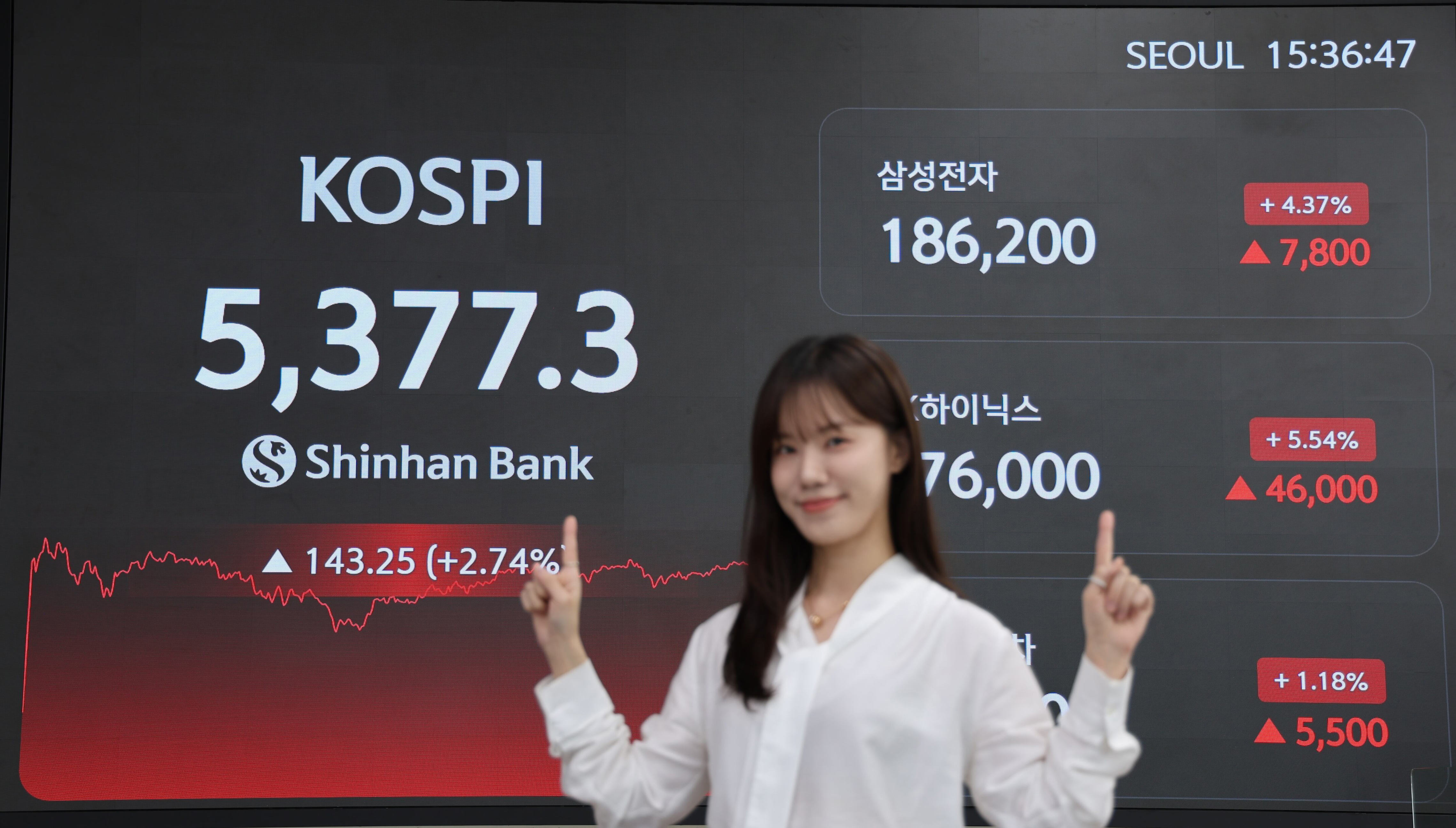
Market Volatility Amid Geopolitical Tensions
Last month, the domestic stock market experienced significant fluctuations due to the ongoing conflict between the U.S., Israel, and Iran. Foreign investors sold off over 35 trillion Korean won worth of stocks in the KOSPI market. However, the actions of high-net-worth individuals, often referred to as 'big hands,' showed a different strategy. These individuals, managing financial assets exceeding 3 billion Korean won, sold defense and nuclear power stocks that had seen brief surges and redirected the proceeds into purchasing over 110 billion Korean won worth of Samsung Electronics alone.
As the first-quarter earnings season approached, foreign investors, who had previously been selling aggressively, began to buy stocks again. Despite the barrage of external negative factors, the market's large funds ultimately focused on the earnings potential of semiconductor companies.
Profit-Taking Amid Crisis: Semiconductor Bets by Big Hands and Foreigners
Big players in the Korean stock market seized the opportunity presented by the geopolitical crisis to adjust their portfolios. According to Samsung Securities, high-net-worth individuals with assets over 3 billion Korean won conducted large-scale net sales of nuclear power and defense stocks during last month’s Iran war. This included significant sales from Doosan Enerbility (-24.7 billion Korean won) and Hanwha Aerospace (-18.4 billion Korean won). They took profits as the Middle East crisis caused short-term surges in related stock prices.
The cash they secured was entirely directed towards semiconductors. In March, the top two net purchase stocks among high-net-worth individuals were Samsung Electronics and SK Hynix. Notably, Samsung Electronics showed strong buying momentum, purchasing 114.3 billion Korean won worth of shares last month, nearly matching the combined net purchases from January to February (156 billion Korean won). SK Hynix also recorded net purchases of 325 billion Korean won. This was driven by confidence in the recovery of the semiconductor industry even amid the crisis. Additionally, the industrial background of increased demand for high-bandwidth memory (HBM) due to the global expansion of the artificial intelligence (AI) industry also stimulated buying sentiment.
Foreign investors, who had been aggressively selling stocks, are showing a clear shift in their supply and demand trends. Last month, foreigners conducted net sales of approximately 35.7 trillion Korean won in the KOSPI market. The foreign ownership ratio in the KOSPI market capitalization fell to an annual low of 36.2% as the exchange rate surged due to the conflict between Israel and Iran. However, this month, the selling pressure has weakened, and they have turned to net purchases (804 billion Korean won as of the 3rd) after 12 trading days, showing signs of a comeback. Considering past precedents where foreigners eventually turned to net buying whenever stock prices fell to bottom levels relative to corporate earnings, there is also analysis suggesting that the current selling trend may be a temporary phenomenon.
Diverging Earnings Forecasts: The Key to Reversal is ‘Samsung Electronics’
The aftermath of the war has clearly divided the earnings expectations of companies. According to FnGuide, Jeju Air (-59.8%) saw the largest decline in operating profit estimates compared to just before the outbreak of the Iran war. This was due to rising aviation costs as international oil prices soared amid concerns over the blockade of the Strait of Hormuz, negatively impacting the travel sector. On the other hand, oil refiners like SK Innovation (6.0%) and S-Oil (6.1%) saw their earnings forecasts significantly revised upward due to expectations of improved refining margins. As oil prices are likely to continue rising for the time being, energy and trading companies, which benefit from high oil prices, are expected to serve as defensive stocks in the market.
However, the sector where securities firms' earnings expectations rose the most was undoubtedly semiconductors. The operating profit estimates for Samsung Electronics and SK Hynix this year were revised upward by 10.9% and 9.5%, respectively, within a month. This was due to the belief that the fundamental improvement trend of recovering global IT demand and rising semiconductor prices would not be broken despite external shocks from the war. Securities industry experts also emphasize the need to focus on fundamentals rather than external variables. Lee Kyung-min, a researcher at Daishin Securities, said, “We have already confirmed robust March exports even amid geopolitical instability,” and added, “The strength of the stock market’s recovery will be determined when attention shifts to fundamentals through Samsung Electronics' preliminary earnings announcement on the 7th.”
Divergent Investment Results: Institutions Defend, Individual Investors Hit
Unlike the swift response of smart money, individual investors were relatively hit hard in this volatile market. According to the Korea Exchange, the average return rate of the top 10 net-purchased stocks by individual investors over the past month was -23.5%. This is more than 7 percentage points below the KOSPI index’s decline rate (-16.2%) during the same period. Individual investors injected funds whenever the prices of semiconductor bellwethers like Samsung Electronics and SK Hynix adjusted, judging it as a buying opportunity at a low point, but the loss widened as stock prices fell further.
On the other hand, institutional and foreign investors partially defended their returns by investing in defense stocks and inverse products. During the same period, the average return rate of the top 10 net-purchased stocks by foreigners was -7.8%, while institutional investors recorded a positive return rate of 3.84%. While most individual investors, excluding high-net-worth individuals, took losses by directly confronting falling quality stocks, institutions constructed defensive portfolios tailored to market conditions and endured the downturn.
월 5900원 멤버십, 신문 독자에게는 2900원, 조선멤버십 55000원 상당의 신문-잡지 8종 마음껏 보기, 조선멤버십 현금처럼 쓸 7000포인트 받아 알뜰한 쇼핑, 조선멤버십